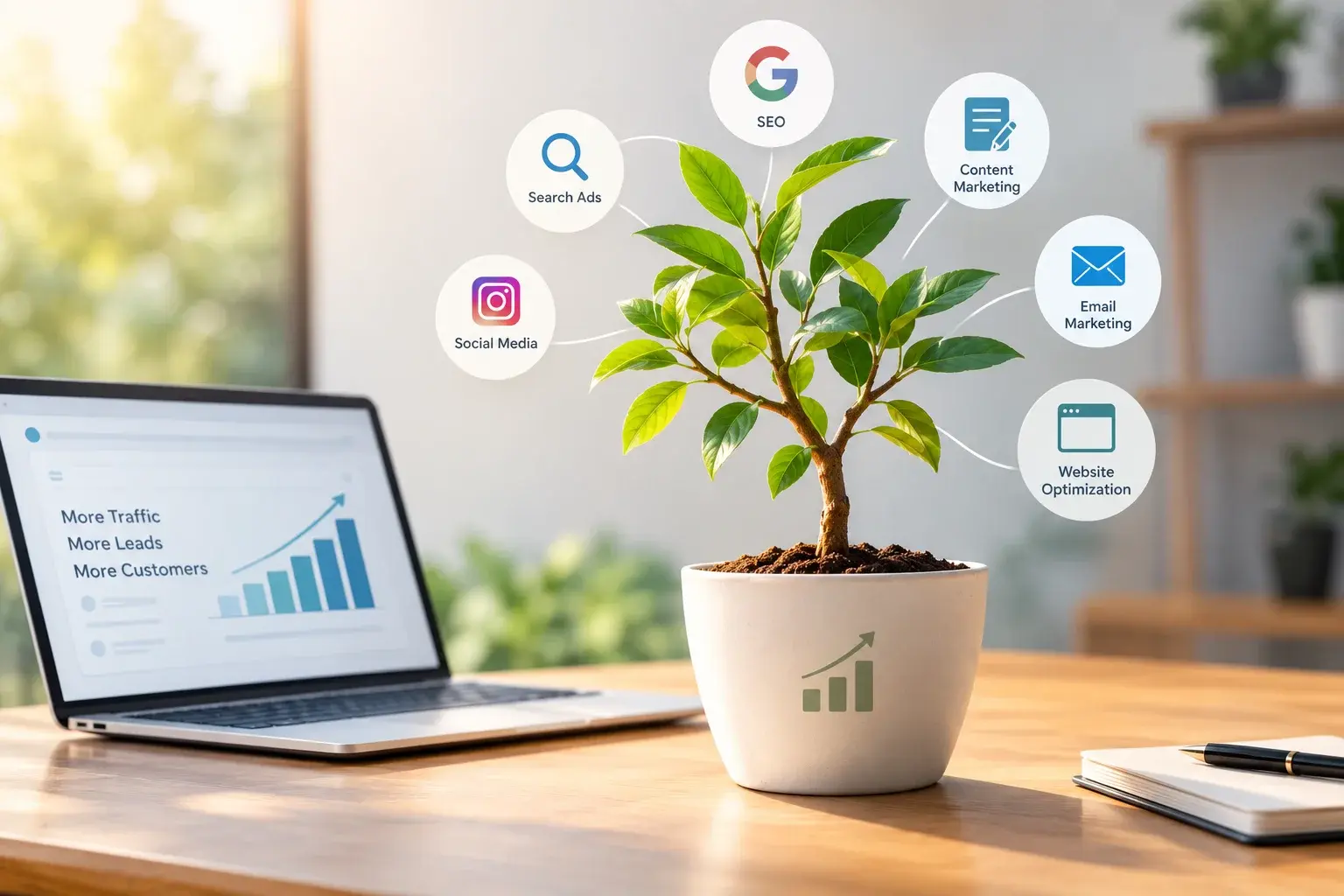
Digital marketing helps businesses grow by increasing online visibility, reaching the right audience, and turning potential customers into paying customers. By building trust, making it easy to take action, and tracking results, businesses can attract more customers and make smarter marketing decisions.
In 60 seconds:
Be found: SEO, local search, and ads put you in front of buyers at the moment they search.
Be trusted: Useful content, accurate listings, and real reviews make buyers pick you over a competitor.
Convert: A clear website with one obvious next step turns visits into enquiries.
Measure: Track enquiries and sales, not just traffic and likes.
Start small: Pick 2 channels, run them for 90 days, then expand.
What Is Digital Marketing, and Why Does It Matter?
Digital marketing is the promotion of a business through online channels: search engines, websites, social media, email, and online ads. Buyers now research a business online before they call or visit. If you are hard to find, unclear, or hard to contact, the customer goes to a competitor.
Every digital marketing activity serves one of three jobs:
Stage | The job | What the customer thinks | Typical channels |
Visibility | Get discovered | "Who can solve this?" | SEO, Google Business Profile, search ads, social posts |
Engagement | Earn trust | "Can I rely on them?" | Blog guides, FAQs, reviews, case studies, email |
Conversion | Get the enquiry or sale | "How do I get started?" | Service pages, quote forms, click-to-call, checkout |
A gap in any one stage leaks growth. Traffic without trust does not convert, and a great offer nobody can find does not sell.
7 Ways Digital Marketing Helps Your Business Grow
Traffic and followers are not the goal. Each of the seven ways below ends in a business result you can count.
1. It Makes You Visible to People Ready to Buy
Customers search before they buy, so the business that appears for the right search gets the first look. A tree removal company with a dedicated page for each service (removal, trimming, stump grinding) and a complete Google Business Profile can appear when someone nearby searches for those exact services. SEO builds this visibility over months; paid search delivers it from the first day the campaign is live and funded.
Action step: List the 5 searches for your ideal customer types, then check which of them show your business today.
2. It Attracts the Right Audience, Not Just More Audience
A website with 5,000 monthly visitors and 3 enquiries has an audience problem, not a traffic problem. Keywords, location targeting, and audience research filter visitors toward people who need your service. An accounting firm serving small companies should publish payroll, GST/VAT, and year-end reporting guides for small companies, not general finance articles.
Action step: Write one sentence describing your best customer: who they are, where they are, and the problem they need solved.
3. It Generates Qualified Leads
A lead is a person who asks for something: a call, a quote, a booking. A renovation company converts better with a separate page for kitchens, bathrooms, and each other service it offers, each with the process, common questions, and a quote button, than with one generic "Services" page. Judge lead quality by how many enquiries become paying jobs; 10 suitable enquiries are worth more than 100 unsuitable ones.
Action step: Add one clear call to action ("Get a free quote") to every service page.
4. It Converts More Visitors Into Customers
Traffic you already pay for is wasted if the website loses people. Visitors leave when the offer is unclear, prices or process are unexplained, contact details are hidden, the page loads slowly, or the checkout has too many steps. Fixing these raises results without raising the advertising budget.
Action step: Open your site on your phone, find your phone number and your quote form in under 10 seconds, and fix whatever takes longer.
5. It Builds Brand Awareness and Trust
People hire businesses they recognise and can verify. A landscaping company that publishes seasonal garden guides, explains its working process, and shows real project photos proves expertise before the first call. Use real reviews and real results only. Invented testimonials and unsupported numbers destroy trust and break the rules of Google and every major ad platform.
Action step: Ask your last 10 satisfied customers for a Google review this week.
6. It Brings Customers Back
Repeat customers cost less to win than new ones. Email reminders, maintenance notices, and useful follow-ups keep your business in front of past buyers: an office supplier can send reorder reminders, and a service company can send seasonal maintenance tips. Email only people who opted in, include an unsubscribe link in every message, and follow your local privacy law.
Action step: Set up one automated follow-up email that sends 30 days after every completed job or purchase.
7. It Shows You What Works
Online channels report what they deliver. Analytics show which pages bring enquiries, which ads waste money, and which channel produces customers at the lowest cost. Attribution is never perfect, because a customer can discover you on Instagram and enquire through Google, but tracking enquiries and sales still beats guessing.
Action step: Install Google Analytics 4 and Google Search Console, and set up conversion tracking for calls and form submissions.
Which Digital Marketing Strategy Fits Your Business?
No single strategy fits every business. Match the channel to how your customers buy.
Strategy | Best for | Time to first results | Ongoing cost | Main risk |
Local SEO + Google Business Profile | Businesses serving a specific area | Weeks to months | Low to medium | Inaccurate business details or weak local relevance |
SEO | Businesses customers search for by service or product | Often 3–6+ months | Low to high | Slow start; no guaranteed rankings |
Paid search (Google Ads) | High-intent searches and urgent services | Potentially within days | Medium to high | Spending without conversion tracking |
Paid social media advertising | Reaching targeted audiences, generating leads and promoting products | Potentially within days | Medium to high | Poor targeting, weak creative or inefficient spending |
Visual products, community brands and audience engagement | Weeks to months | Low to medium | Posting without a clear purpose | |
Complex or high-value services with a research phase | Often several months | Medium | Prioritizing publishing volume over usefulness | |
Email marketing | Repeat customers and longer decision cycles | Potentially immediate for an engaged list | Low to medium | Sending emails without proper consent |
Time ranges are typical planning ranges, not guarantees. Results depend on competition, website quality, and search demand in your market.
The rule we give every client: choose 1 or 2 channels that match your immediate goal, make sure your website supports that goal, and measure for 90 days before adding more.
Case Walkthrough, Tools, and a 30-Day Starter Plan
Example: A Local Tree Care Company Moving Beyond Referrals
The company gets most work by word of mouth and wants more online enquiries. The sequence below works for any local service business:
Rewrite the website so each service it actually offers (removal, trimming, stump grinding) has its own page with the process, a short FAQ, and a quote form.
Complete the Google Business Profile: correct hours, service areas, services, and photos of real jobs.
Publish 1 helpful article per month, such as how to tell whether a tree needs removal.
Put the phone number and quote button at the top of every page.
Run a small paid search test for the single most profitable service.
Log every call and quote request, its source, and whether it became a completed job.
Do not create near-identical pages for every nearby town, and do not claim areas you do not serve. Both hurt trust and search performance.
Free and Low-Cost Tools to Start With
Tool | Use it to | Cost |
Google Analytics 4 | See traffic sources and configured conversions | Free |
Google Search Console | Track search clicks, impressions, queries, and indexing problems | Free |
Google Business Profile | Manage your local listing, reviews, and call and direction insights | Free |
Meta Business Suite | Schedule and review Facebook and Instagram content | Free |
Google Ads | Run and measure paid search campaigns | Pay per click |
Spreadsheet (Sheets or Excel) | Log leads, sources, and sales when you have no CRM yet | Free |
These tools answer different questions. Search Console shows how people find you in Google; Analytics shows what they do on your site. Neither shows the full value of a customer, so add your own sales log.
Your 30-Day Starter Plan
Days | Priority | What to do | Done when |
1 to 7 | Foundation | Write your goal, your ideal customer, and your current numbers (monthly enquiries, monthly sales, website visits). Install Analytics and Search Console. | You have a written baseline |
8 to 14 | Fix your presence | Update service pages, check mobile layout, complete your Google Business Profile. | Every service has its own page with a contact option |
15 to 21 | Start reaching customers | Publish 2 useful articles or FAQs and launch 1 channel (local SEO, a small ad test, or email). | One channel is live and tracked |
22 to 30 | Review | Compare enquiries and conversions with your baseline, then choose the next 3 improvements. | You have a prioritised list for month 2 |
Thirty days sets up the system. SEO and content need 3 to 6 months of consistent work before trends become clear.
How to Measure Whether Digital Marketing Is Growing Your Business
Tie every activity to a business outcome. A rise in visits or likes proves attention; only enquiries, sales, and repeat orders prove growth. Track the metrics below, starting with the ones in bold.
Metric | What it tells you | How to calculate it |
Qualified enquiries | Whether marketing produces real sales opportunities | Count of enquiries that fit your service and budget |
Conversion rate | How well your website turns visitors into enquiries | Enquiries ÷ visitors × 100 |
Cost per lead | What each enquiry costs you | Marketing spend ÷ number of leads |
Customer acquisition cost | What each paying customer costs you | Marketing spend ÷ new customers |
Return on ad spend | Revenue earned per unit of ad spend | Ad-attributed revenue ÷ ad spend |
Search impressions and clicks | Whether your visibility is growing | Google Search Console |
Repeat purchase rate | Whether customers return | Returning customers ÷ total customers × 100 |
Example: you spend 20,000 on ads and receive 40 enquiries, so your cost per lead is 500. If 8 of those become customers, your customer acquisition cost is 2,500. If each customer is worth 15,000 in revenue, the channel pays for itself. If each is worth 2,000, it loses money no matter how many leads it produces.
Review paid campaigns weekly, and review SEO and content results monthly, because organic results move slowly.
6 Digital Marketing Mistakes to Avoid
Spreading your budget across too many channels? Start with one or two strategies that fit your goals and available resources.
Getting traffic but few enquiries? Revisit your audience targeting, website messaging, and calls to action.
Seeing visitors leave your website? Check page speed, mobile usability, and how easily visitors can contact you.
Getting likes but not enough customers? Measure qualified leads, conversions, and sales alongside engagement.
Spending on ads without knowing what works? Configure conversion tracking before launching campaigns.
Giving up because results are slow? Set realistic review periods and evaluate each channel using relevant performance data
Frequently Asked Questions
How does digital marketing help a small business grow?
It makes the business easier to find, builds trust before the first contact, converts visitors into enquiries, and brings past customers back. Because results are measurable, the budget goes to what works.
What is the best digital marketing strategy for a small business?
The best one matches how your customers buy. Local service businesses start with local SEO and a clear website. Online stores start with product pages and search campaigns. Businesses selling to other companies start with educational content and structured follow-up.
Can digital marketing increase sales?
Yes, when the offer, price, and sales process are sound. Marketing delivers qualified enquiries; your service quality and follow-up turn them into sales. No agency can honestly guarantee a sales figure.
How can a local business grow online?
Complete your Google Business Profile, give each service its own page, collect genuine reviews, and make calling or requesting a quote possible in one tap. Then add paid search for your most profitable service.
Which tools should a small business start with?
Google Analytics 4, Google Search Console, and Google Business Profile, all free. Add Meta Business Suite if you post on Facebook or Instagram, and Google Ads when you are ready to pay for traffic.
How much should a small business spend on digital marketing?
Set the budget from your numbers: your average sale value, your profit margin, and the number of customers you want. Start with a test budget you can afford to lose for 90 days, then increase spend only on channels with a cost per customer below your profit per customer.
How long does digital marketing take to work?
Paid ads send visitors within days of launch. Local SEO typically needs 2 to 3 months, and SEO and content marketing need 4 to 6 months of consistent work before the trend is clear.
Start With a Clear Plan
Growth online comes from knowing your customer, choosing the right channels, stating your value plainly, and measuring what happens. Begin with the biggest gap in your current marketing, fix it, and build from there.
At Shiv Software Experts (SSE), we help businesses build focused digital marketing plans around their goals, website, and budget. Contact SSE to discuss your business goals and get a clear next-step plan.